

There is a cave in the hill above Llwyngychwydd Farm, just outside Llanwrtyd Wells.
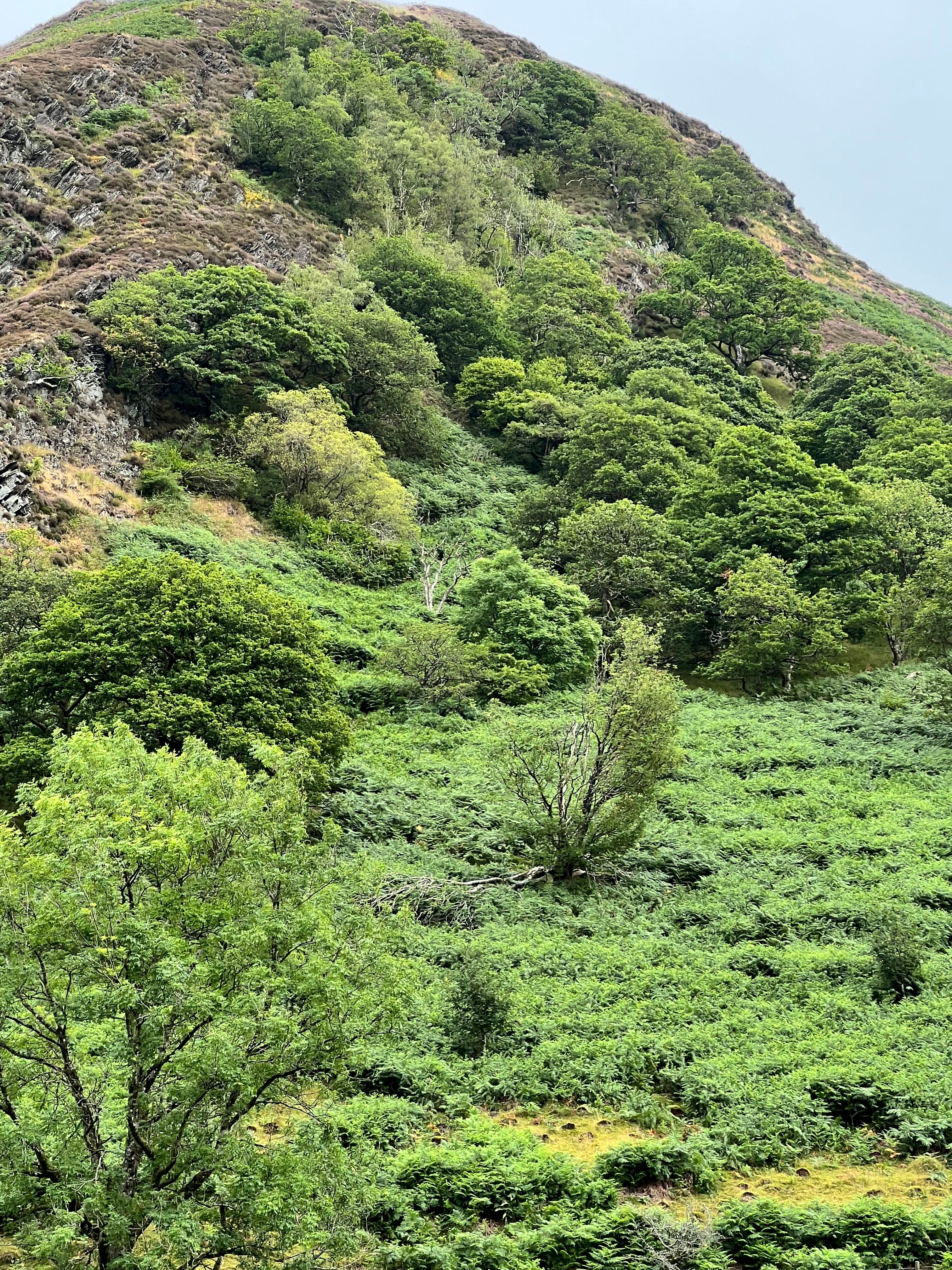
I have known it for years. Llwyngychwydd is my family’s farm, and locally the cave has long been known as Rhys Gethin’s Cave.
Like many things you grow up around, you don’t necessarily stop to ask why.
I did recently.
And what started as a piece of Llanwrtyd folklore has led back more than six hundred years, to the rebellion of Owain Glyndŵr and to a man who may have been one of his most important military commanders.
Rhys Gethin
Rhys Gethin is one of the intriguing figures of Glyndŵr’s great Welsh revolt of 1400–1415.
A man of that name appears in records of the rebellion. Rhys Gethin was associated with the campaigns in south and mid Wales and appears among the Welsh leaders involved in the capture of Carmarthen in 1403.
Another record places a Rhys Gethin raising men in Buellt — the old Welsh territory around Builth — for operations against the English.
Later tradition went further. Rhys Gethin became remembered as one of Glyndŵr’s great generals, sometimes credited with commanding Welsh forces at the extraordinary victory over Edmund Mortimer at Bryn Glas, near Pilleth, in 1402.
But there is a problem.
History appears to have contained two Rhys Gethins.
One was associated with Nant Conwy in north Wales.
The other belonged to Buellt.
For generations, many historians assumed that the famous commander was the northern man.
Welsh historian Cledwyn Fychan challenged that identification. His research argued that the Rhys Gethin appearing prominently in Glyndŵr’s rebellion was instead Rhys Gethin of Llwyngwychwyr, Llanwrtyd.
Llwyngwychwyr is the old name associated with the place we know today as Llwyngychwydd Farm.
Our farm.
A medieval family at Llwyn-y-gwch
There is evidence considerably older than the local legend.
The University of Wales’s scholarly edition of the works of the fifteenth-century poet Guto’r Glyn records the ancestry of another remarkable Welsh soldier, Sir Rhisiart — Richard — Gethin of Buellt.
His father was Rhys Gethin.
His grandfather was recorded as:
Owain of Llwyn-y-gwch.
Llwyn-y-gwch is associated locally with the same holding at Llwyngychwydd.
The resulting medieval family line is strikingly simple:
Owain of Llwyn-y-gwch
Rhys Gethin
Sir Richard Gethin of Buellt
Richard went on to become a professional soldier and knight during the Hundred Years’ War.
More importantly for our story, the modern editors of the medieval Welsh material conclude that his father, Rhys Gethin, fought for Owain Glyndŵr.
Cledwyn Fychan went considerably further, identifying him specifically as the Rhys Gethin of Llwyngwychwyr at Llanwrtyd.
Then there is the cave
This is where the story becomes rather wonderful.
In 1854, Archaeologia Cambrensis, the journal of the Cambrian Archaeological Association, published an account of antiquities around Llanwrtyd.
The writer recorded a particular local tradition.
On a farm called Llwyngwychwyr, in the rock at Gallt y Waen, local people showed visitors a place they called the Cave of Rhys Gethin.
That was written more than 170 years ago.
The farm is still here.
The hill is still here.
And so is the cave.
I’ve been there.
What makes the 1854 account particularly interesting is that its writer doesn’t present Rhys Gethin as a romantic national hero or Glyndŵr’s famous general.
The local tradition remembered him rather differently: as an outlaw or robber, hiding in the landscape and associated with stories and verse.
That may actually make the evidence more interesting.
This doesn’t look like somebody reading a history of Owain Glyndŵr and subsequently attaching a famous name to a convenient cave.
It appears to preserve an independent local tradition connecting a man called Rhys Gethin with this particular farm and this particular cave.
Rebel or robber?
Perhaps the distinction wasn’t always as obvious as it sounds today.
If Cledwyn Fychan’s reconstruction is correct, Rhys Gethin and members of his family joined Glyndŵr’s rebellion at its beginning.
Research cited by Fychan indicates that members of the family lost lands in Buellt because of their participation in the rising.
To the Welsh rebels, these men were fighting for their country and their prince.
To Henry IV’s government, they were traitors and outlaws.
Six hundred years later, perhaps fragments of both stories survive.
One in the historical records.
The other in a cave beneath a hill at Llanwrtyd.
Was he really Glyndŵr’s general?
This is where we have to be careful.
We can say with considerable confidence that there was a Rhys Gethin of Buellt associated with Owain Glyndŵr’s rebellion.
There is good medieval genealogical evidence for the family.
There are contemporary records concerning a Rhys Gethin during the rebellion.
Modern medieval scholarship accepts Rhys Gethin, father of Sir Richard Gethin of Buellt, as a supporter or lieutenant of Glyndŵr.
Cledwyn Fychan’s research identifies that man with Llwyngwychwyr at Llanwrtyd.
And independently, in 1854, Rhys Gethin’s cave was recorded on that same farm.
What remains less certain is whether every famous exploit subsequently attributed to “Rhys Gethin” belongs to this man.
In particular, the claim that he commanded at Bryn Glas isn’t yet something we can prove.
Nor can we safely repeat the later story that he died at Grosmont in 1405 as established fact.
Six centuries of history have blurred two men with the same name.
Untangling them is part of the story.
Six hundred years later
For me, that’s what makes this fascinating.
This isn’t a castle or battlefield where somebody has erected a plaque telling visitors what happened.
It’s a working Mid Wales farm.
Sheep are still farmed on the same landscape.
The old Welsh place-names survive in different forms: Llwyn-y-gwch, Llwyngwychwyr, Llwyngychwydd.
And above the farm is a physical feature that people were calling Rhys Gethin’s Cave at least as far back as 1854 — and probably long before anyone thought to write it down.
Somewhere around 1400, a man called Rhys Gethin left this part of Wales and joined one of the defining events in Welsh history.
He may have become one of Owain Glyndŵr’s leading commanders.
His son became Sir Richard Gethin, a soldier whose career took him far beyond the hills of Buellt.
But the father’s name remained here.
Attached to a farm.
Attached to a hill.
And attached to a cave.
We’re now searching old maps, deeds, pedigrees and medieval records to see how much further back that connection can be documented.
Perhaps somewhere in an archive is the piece of paper that finally connects all of it.
Until then, the cave remains exactly where it has presumably been for centuries.
Above Llwyngychwydd.
Waiting.
Diddorol iawn!